Every homeowner in the Triangle area who has watched a sudden downpour transform their backyard into a muddy pond knows the frustration firsthand. Planning a beautiful patio or outdoor living space means nothing if the ground beneath it cannot handle moisture. In Wake County and across the Piedmont, the answer to that problem sits just a few inches below the surface.
The dominant soil type throughout the Raleigh region is the Cecil soil series, a dense kaolinite clay that acts as a near-impervious barrier to water. This heavy red layer typically begins four to eight inches beneath the topsoil and extends several feet deep. With annual rainfall averaging around 46 inches, that water has to go somewhere, and clay will not let it pass through.
Understanding drainage before breaking ground on any hardscape project is not optional here. It is the single most important factor separating a patio that lasts twenty years from one that buckles and cracks within two.
The Science Behind Red Clay Drainage Failure
Clay particles are extraordinarily small, packing together into a dense matrix that leaves virtually no pore space for water movement. Percolation rates in our local Cecil soil measure in tiny fractions of an inch per hour, meaning surface water simply cannot infiltrate the ground at any useful speed.
Instead of soaking downward, rainfall spreads laterally across the clay layer, following gravity to the lowest spot on your lot. In flat yards common throughout neighborhoods like North Hills, Brier Creek, and Wakefield, that water has nowhere to travel and simply pools until evaporation takes care of it, sometimes days later.
The Shrink-Swell Problem
Cecil soil does not stay in one shape. When saturated, it swells by five to ten percent. When dry summer heat bakes the moisture out, it contracts and cracks. This continuous cycle of expansion and contraction puts enormous stress on anything built on top of it.
The consequences show up in predictable ways:
- Cracked mortar joints: Rigid connections snap under shifting pressure.
- Tilted pavers: Individual stones heave upward, creating trip hazards.
- Leaning retaining walls: Saturated clay pushes laterally against block faces.
- Sunken walkways: High-traffic areas compact unevenly where moisture collects.
A standard twenty-foot patio sitting on untreated red clay can experience over an inch of seasonal movement. That kind of shifting will destroy even the highest-quality surface materials.
What Happens When Drainage Is Ignored
Skipping proper subsurface preparation in an effort to save money is one of the most expensive mistakes a homeowner can make. Hardscapes Raleigh sees the results of this shortcut regularly, and the damage follows a consistent pattern.
Persistent Standing Water
The most immediate sign of failure is water that refuses to leave the surface after rainfall. Pooling moisture stains pavers with mineral deposits, promotes slippery algae growth, and creates ideal breeding habitat for mosquitoes during our humid summers. An outdoor entertainment area that stays flooded for days after every storm is an outdoor space nobody uses.
Progressive Structural Failure
A patio base built directly on red clay without adequate gravel beneath it will begin shifting within the first two full seasonal cycles. Initial movement creates low spots. Low spots trap more water. Extra water saturates the clay further, accelerating the settling. This feedback loop ultimately destroys the entire installation.
Foundation Risk
Water that cannot drain away from your hardscape migrates toward the path of least resistance, which is often your home’s foundation. Many houses in the area sit on relatively shallow footings surrounded by dense clay. Poor exterior drainage directly contributes to crawl space moisture problems, basement intrusion, and foundation settlement. Fixing those issues costs far more than the patio itself.
Proven Drainage Solutions for Local Hardscape Projects
Managing water effectively on Piedmont clay requires a layered approach. No single technique solves every problem; instead, several systems work together to intercept, channel, and discharge moisture safely.
Precision Grading
Every hardscape surface must slope away from the home at a minimum pitch of one-quarter inch per foot, roughly a two-percent grade. This angle is nearly invisible to the eye but remarkably effective at directing runoff. The grading must extend beyond the paved area itself so surrounding landscape can receive and channel the flow. Wake County stormwater ordinances require that runoff be managed without flooding neighboring properties, making proper grading both a practical and legal necessity.
Designers should map a continuous downhill path from the patio to an appropriate discharge point, whether that is a rain garden, natural swale, or municipal connection.
Deep Compacted Gravel Base
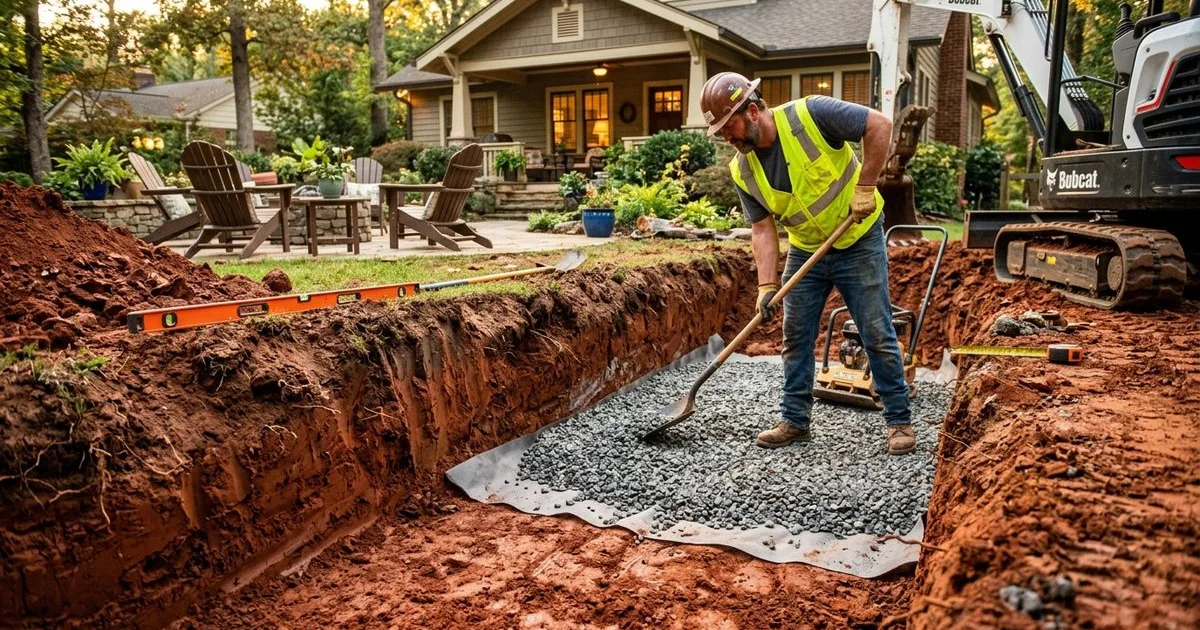
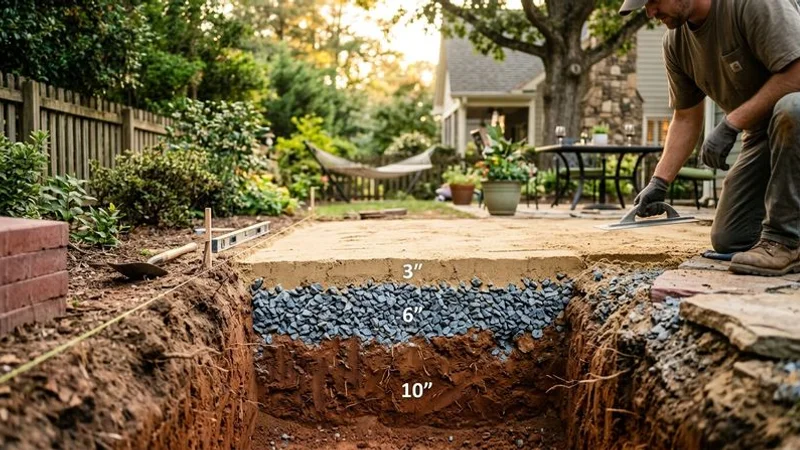
A thick gravel base serves two purposes simultaneously. First, it creates a dimensionally stable foundation that does not move with seasonal moisture changes. Second, the porous stone allows water to flow laterally beneath the surface rather than pooling against the patio from below.
For standard residential patios, a minimum of six inches of compacted gravel is necessary. Areas bearing heavy loads, like outdoor kitchens or fire pit surrounds, should increase to eight or ten inches. Number 57 stone, an angular crushed aggregate, is preferred throughout the Piedmont because its sharp edges interlock when compacted, forming a rigid yet permeable foundation. Extending the gravel bed several inches beyond the paver edges further improves lateral drainage.
French Drain Systems
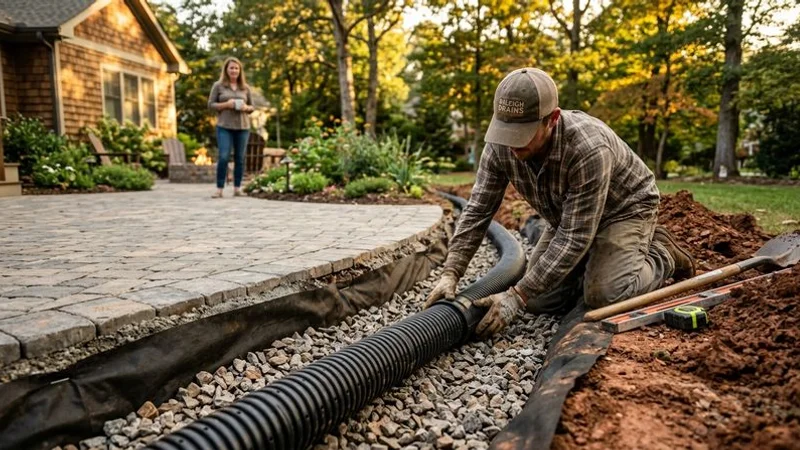
French drains handle subsurface water that migrates through the base layer. A perforated pipe surrounded by clean gravel sits in a trench along the patio perimeter, collecting water and routing it safely away from the home.
Proper installation requires a minimum one-percent slope, about one inch of fall per eight feet of run. Four-inch diameter pipe, either corrugated or rigid PVC, is standard. Critical details include:
- Wrapping the trench in non-woven filter fabric to prevent clay migration into the gravel.
- Connecting to a municipal stormwater system where permitted.
- Using a daylight outlet at the property edge for gravity discharge.
- Dispersing flow into a dedicated rain garden or bioswale.
Channel Drains
Where a patio meets a house wall or door threshold, a channel drain intercepts fast-moving sheet water before it can breach the foundation. Products like the NDS Slim Channel system, a two-inch wide extruded PVC drain with slotted grates, can handle up to 21 gallons per minute and fit flush with the finished surface.
Dry Creek Beds
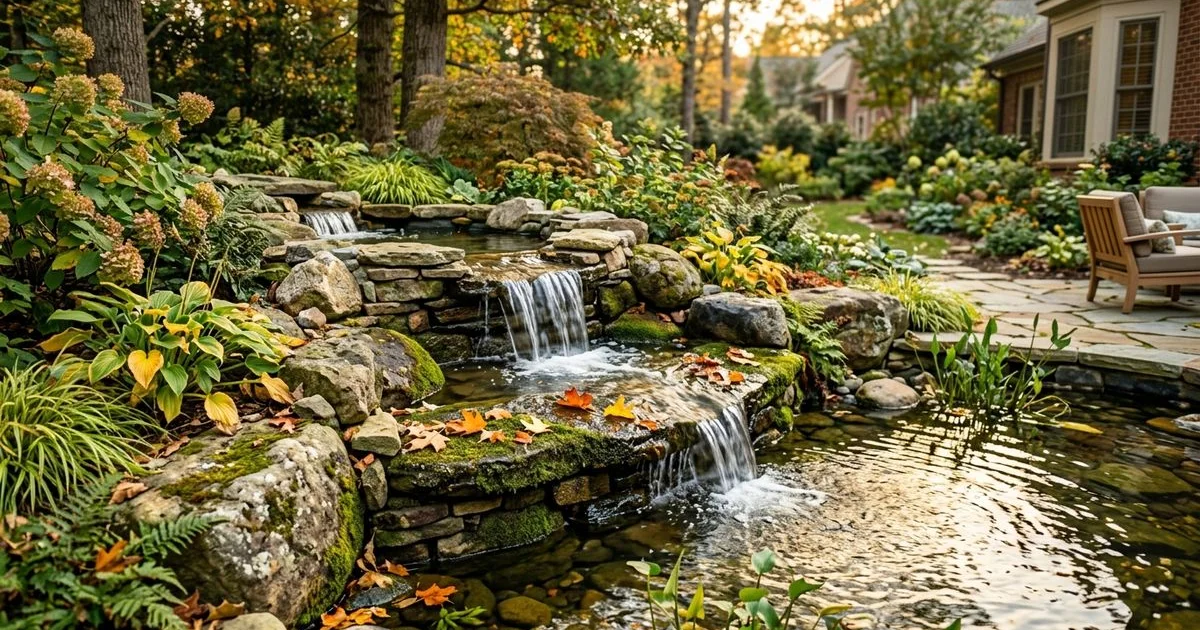
Dry creek beds provide both functional drainage and visual appeal. Using varied sizes of decorative river rock, these features create a natural-looking channel that conveys stormwater during heavy rains and serves as a landscape accent during dry weather. Bordered by drought-tolerant native plantings, dry creek beds work beautifully as the final discharge point for French drain systems, bridging the gap between structured entertaining spaces and natural yard areas.
What Proper Drainage Costs
Investing in correct subsurface infrastructure adds fifteen to twenty-five percent to the base price of a hardscape installation. For a typical Raleigh-area paver patio, that translates to an additional $2,000 to $5,000.
| Drainage Feature | Function | Average 2026 Added Cost |
|---|---|---|
| Compacted #57 Gravel Base | Prevents settling and provides sub-surface flow | 10% - 15% of project base |
| French Drain System | Channels heavy subsurface water away | $60 - $90 per linear foot |
| NDS Slim Channel Drain | Intercepts surface water near home foundations | $100 - $150 per linear foot |
That upfront cost is non-negotiable when building on Piedmont clay. The alternative is far worse: tearing out a failed installation, re-grading, installing the infrastructure that should have been there originally, and rebuilding the surface from scratch.
A full replacement usually costs three to five times more than doing it correctly the first time.
Choosing the lowest bid almost always means the contractor skipped steps beneath the surface. The pavers and stone get all the attention, but the invisible work underground determines whether your space lasts a generation or fails in two seasons.
Build on a Solid Foundation
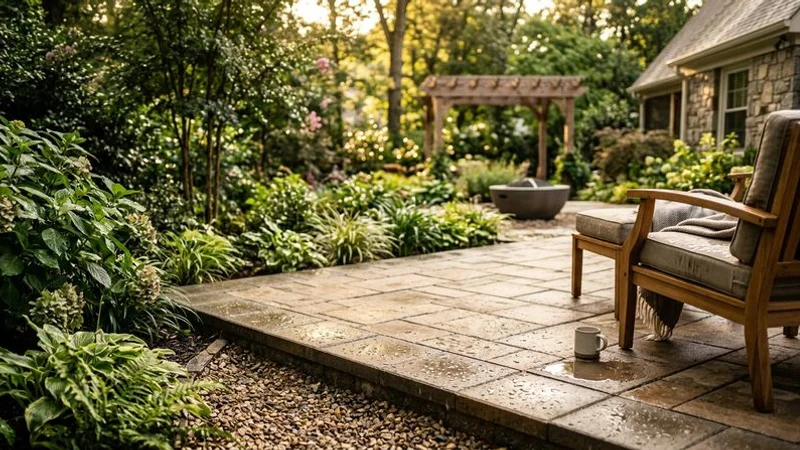
Red clay is a geological reality across the Triangle, and every outdoor project must account for it from the very first design conversation. The difference between a patio that performs beautifully for decades and one that sinks within months comes down entirely to what happens before the first paver is placed.
Our network of vetted professionals designs every backyard project with water management as the foundational requirement. Schedule a design consultation to discuss your specific property conditions and get a plan that protects your investment for the long haul.